Attach It to Something You Already Do: Habit Stacking for a Meditation Practice That Actually Sticks
For the first two years I tried to meditate, my plan was always some version of "I'll do it when I have a quiet moment." Some days that quiet moment showed up. Most days it didn't, and not because my life was unusually chaotic — just because "whenever I have a quiet moment" isn't a plan, it's a hope. A hope with no time attached to it loses to literally anything else that has a time attached to it, every single day, forever.
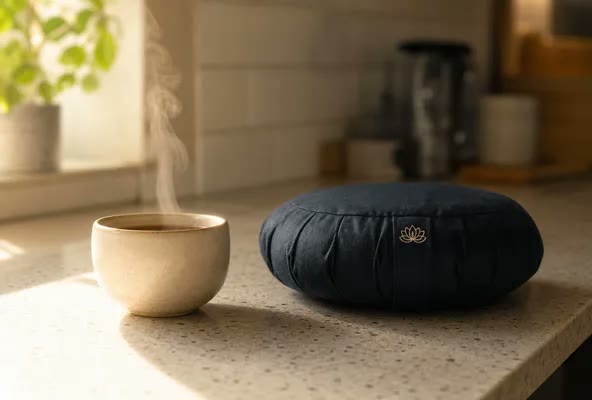
What actually fixed it wasn't more discipline. It was noticing that I already had a handful of habits so automatic I couldn't skip them if I tried — I have never once forgotten to make a cup of tea in the morning. Not once. Nobody has ever had to remind me. So I stopped trying to build meditation as its own standalone habit and started attaching it to the one that was already unbreakable.
The real reason I still forget to meditate
Here's the thing about a brand-new habit: it has no natural trigger. Brushing your teeth has one — the fuzzy feeling in your mouth. Checking your phone has one — the buzz in your pocket. Meditation, especially early on, has nothing. There's no physical sensation that says "now would be a good time to sit down and watch your breath." So it lives or dies entirely on memory and motivation, and both of those are unreliable on a Tuesday when you're running late.
I used to think I was just bad at consistency. I've since coached enough people through the exact same thing to know that's almost never what's actually going on. If you've read my piece on getting back on track after missing a week, you know I don't think missed days are a character flaw — but I'd rather solve the problem upstream of the guilt entirely, and that means giving the habit a trigger it doesn't have to borrow from willpower.
Borrow a habit that already works
This is the whole idea, and it's not mine — habit stacking has been written about for years, but it clicked for me the moment I stopped treating it as a productivity trick and started treating it as a trigger transplant. You take a habit you already do automatically, every day, without deciding to, and you graft the new habit directly onto the end of it. Not "sometime in the morning." Not "after breakfast, roughly." Immediately after. Same physical spot, same order, every time, until the second habit starts triggering off the first one the same way the first one triggers off waking up.
The habit doesn't need more willpower. It needs a trigger that already works.
The formula is almost insultingly simple: "After I [thing I already do without fail], I will [new habit], for [absurdly small amount]." The size matters as much as the sequencing — I go into why short really is enough in how long a beginner should actually meditate. A two-minute sit stacked onto an existing habit will survive contact with a busy week. A twenty-minute sit with no anchor at all won't, no matter how motivated you feel writing it into your planner on Sunday night.

How to actually pick your anchor
Not every existing habit makes a good anchor. The ones that work share three things: they happen at roughly the same time every day, they happen in roughly the same physical spot, and you've never once needed a reminder to do them. If you have to think about whether you did it today, it's too weak to build on. Good candidates, for most people: the first sip of coffee or tea, brushing your teeth, sitting down at your desk, plugging in your phone at night, closing your laptop at the end of the workday.
- Pick the anchor first, the time second. Don't decide "I'll meditate at 7am" — decide "I'll meditate right after I pour my tea," whatever time that turns out to be that day.
- Keep the new habit smaller than the anchor. If pouring tea takes fifteen seconds, a ten-minute meditation feels like a mismatched sequel. Two minutes feels like a natural continuation.
- Do it in the same spot as the anchor, not somewhere else. If the tea happens in the kitchen, don't walk to the bedroom to meditate — sit right there. Moving breaks the chain before it forms.
My stack, right now
After I pour my morning tea, I sit down at the kitchen table — still standing is fine too — and close my eyes for two minutes before I let myself take the first sip. That's it. The tea is right there getting slightly less hot, which is its own quiet bit of accountability; I've never once forgotten to meditate first because the tea is the whole reason I'm standing in that spot at that moment. I didn't have to add a reminder, an app, or a note on the fridge. The trigger already existed. I just borrowed it. Anchors get harder to protect once other people are awake, which is where meditating with kids underfoot picks up.
It took about three weeks before it stopped feeling like an extra step and started feeling like part of making tea. Now skipping the two minutes feels stranger than doing them — which is exactly the point. A stacked habit eventually stops needing motivation altogether, because the anchor is doing the remembering for you.
When the stack breaks
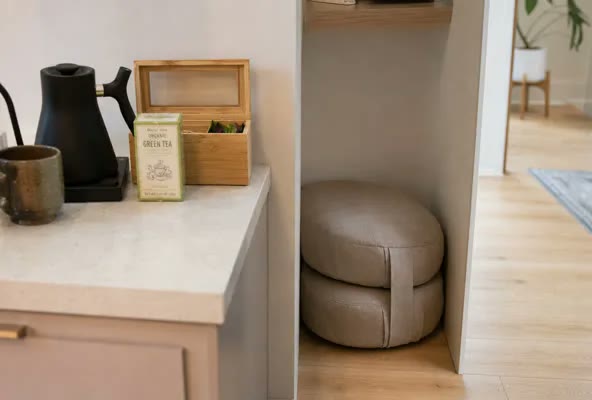
Travel, a broken routine, a house guest using your kitchen table before you — sometimes the anchor itself gets knocked loose, and the meditation goes with it. That's normal, and it's a different problem than the one this piece is about; if you're trying to keep a practice alive when your whole schedule is upside down, I've written separately about what actually gets me back on the cushion after a gap. The stack isn't meant to be unbreakable. It's meant to make the ordinary days — the ones with no chaos in them at all — reliable by default, instead of one more thing you have to remember on top of everything else.
You don't need a better version of yourself to make this stick. You need a habit you already do without fail, and two minutes tacked onto the end of it. If you want a ready-made anchor to attach it to, a five-minute morning routine is the one most people already have room for.
Start with the 3-Minute Meditation Pack
One short guided practice each for stress, sleep, and confidence, straight to your inbox.
Get the free packThis article is general educational content, not medical or psychological advice. See the disclaimer for detail.