Meditating With Kids Underfoot: What Actually Works
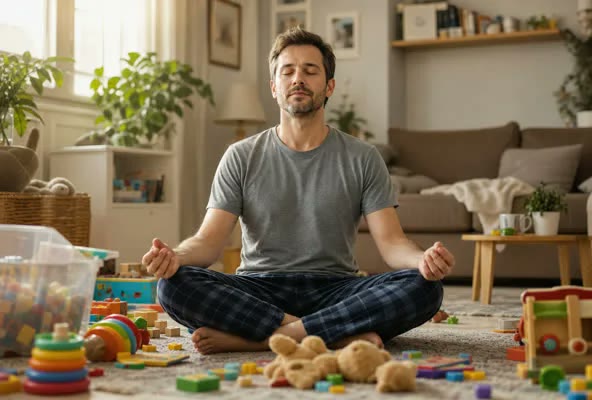
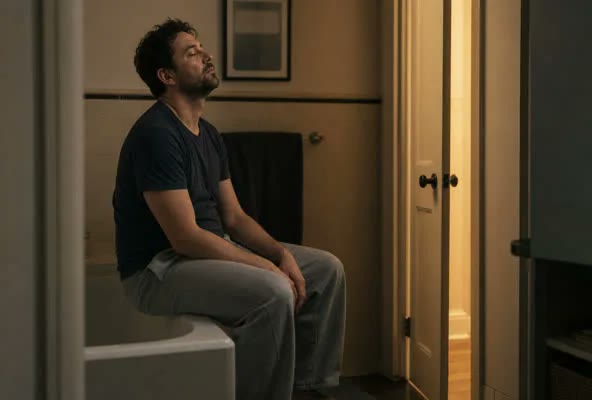
For years I pictured meditation the way it looks in the apps: a clean room, a candle, maybe a plant, total silence. Then over 30 years ago we had kids, and that picture quietly disappeared. Back then my meditation space was wherever I happened to be standing when I got sixty seconds to myself, which was often the kitchen, sometimes the car, and more than once, I'll admit, in the "smallest room" in the house where I might get a few minutes' peace.
My kids are grown now, but I still remember exactly what those years were like, and I hear from plenty of parents living through them right now. If you're a parent and you've mostly given up on meditating because your house is loud and your time isn't your own, I want to talk you out of giving up. Not because you're doing it wrong, but because the version of meditation that requires silence and privacy was never really built for people raising small kids. There's a version that fits into the actual chaos, and it still works.
The guilt of a locked door
The hardest part isn't finding the time, honestly. It's the guilt that shows up the second you try to take it. Closing a door for ten minutes while your kids are awake in the house can feel selfish in a way that's hard to explain to someone without kids. I used to sit down, close my eyes, and spend the whole two minutes half-listening for footsteps instead of actually meditating. That's not relaxing. That's just sitting still while stressed, which is its own special flavor of not helpful.
What changed things for me wasn't finding more time. It was giving myself permission to stop treating interruption as failure. If I was two breaths into a sit and someone needed a snack, that wasn't a ruined meditation. That was a meditation that happened to be two breaths long that day. I stopped assuming that meditation was hours long. You've probably heard the phrase little and often. It's true. I actually go into the mental shift that made this click for me in how I get back on track after missing days — a lot of the same guilt shows up whether the interruption is a busy week or a toddler.
What actually works when you have zero privacy
Here's the honest list of things I've actually done, not the aspirational version:
- The ninety-second bathroom sit. Not glamorous, but a closed door ANYWHERE and a minute of slow breathing resets more than you'd think. I stopped waiting for a "real" opportunity and started taking this one.
- Meditating in the car before I went inside. After school pickup, before I walked in the door, I'd sit in the driveway for two or three minutes with the engine off. It was the single best transition tool I found between "work brain" and "present parent."
- Doing it with noise instead of around it. I used to think I needed quiet. Instead I learned to breathe through the noise — the show playing, the sibling argument two rooms over, all of it. It wasn't as deep a practice, but it was a real one, and it taught me something silence never did: how to stay steady when things aren't calm.
- Walking it instead of sitting it. Some of my best "sits" happened walking around a supermarket. If sitting still isn't realistic for your life right now, I wrote a whole piece on meditating without sitting still that's basically permission to stop forcing the cushion.

You don't need silence. You need sixty seconds and permission to stop waiting for the quiet version.
The days it just doesn't happen
I want to be straight with you: some days there was genuinely no window. A sick kid, an early meeting, a morning that was just chaos front to back. On those days I didn't force it, and I didn't beat myself up about it either. What I learned is that the practice doesn't need to happen every day to keep working. If you're newer to this and worried about how short is "too short" to count, the honest answer — which I go into more in how long a beginner should actually meditate — is that even a minute counts more than people expect. The bar is lower than the apps make it look.
What I wanted my kids to see
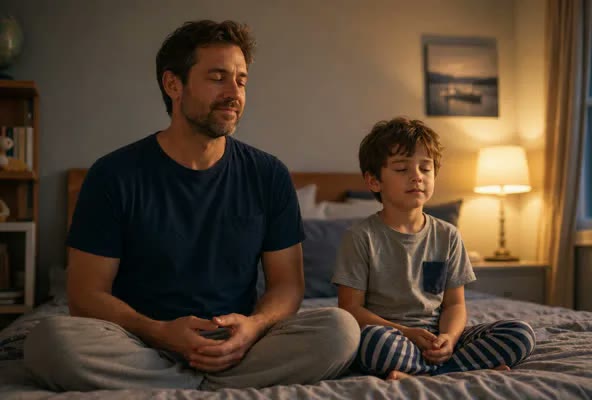
The thing that eventually made peace with the mess of it all wasn't a productivity hack, it was a shift in what I thought I was modeling. I used to think I needed to protect my kids from seeing me meditate, like it needed to happen off to the side, away from them, so it wouldn't get interrupted. Then I flipped it. I wanted them to see it. I wanted "sometimes people sit quietly and breathe for a minute, even when things are loud" to just be a normal, unremarkable thing that happened in our house, the same way they saw me make a cup of tea or answer my phone.
All those years ago sometimes my son would ask me what I was doing. It wasn't really a teaching moment. I just told him it helped me to stay calm. It didn't stop him interrupting me from time to time, but it did seem to make those interruptions less annoying!
So if your practice these days looks more like a minute in the driveway than a serene morning ritual, you're not doing it wrong. You're doing the version that actually fits the life you have right now, which is the only version that was ever going to stick.
Start with the 3-Minute Meditation Pack
One short guided practice each for stress, sleep, and confidence, straight to your inbox.
Get the free packThis article is general educational content, not medical or psychological advice. See the disclaimer for detail.