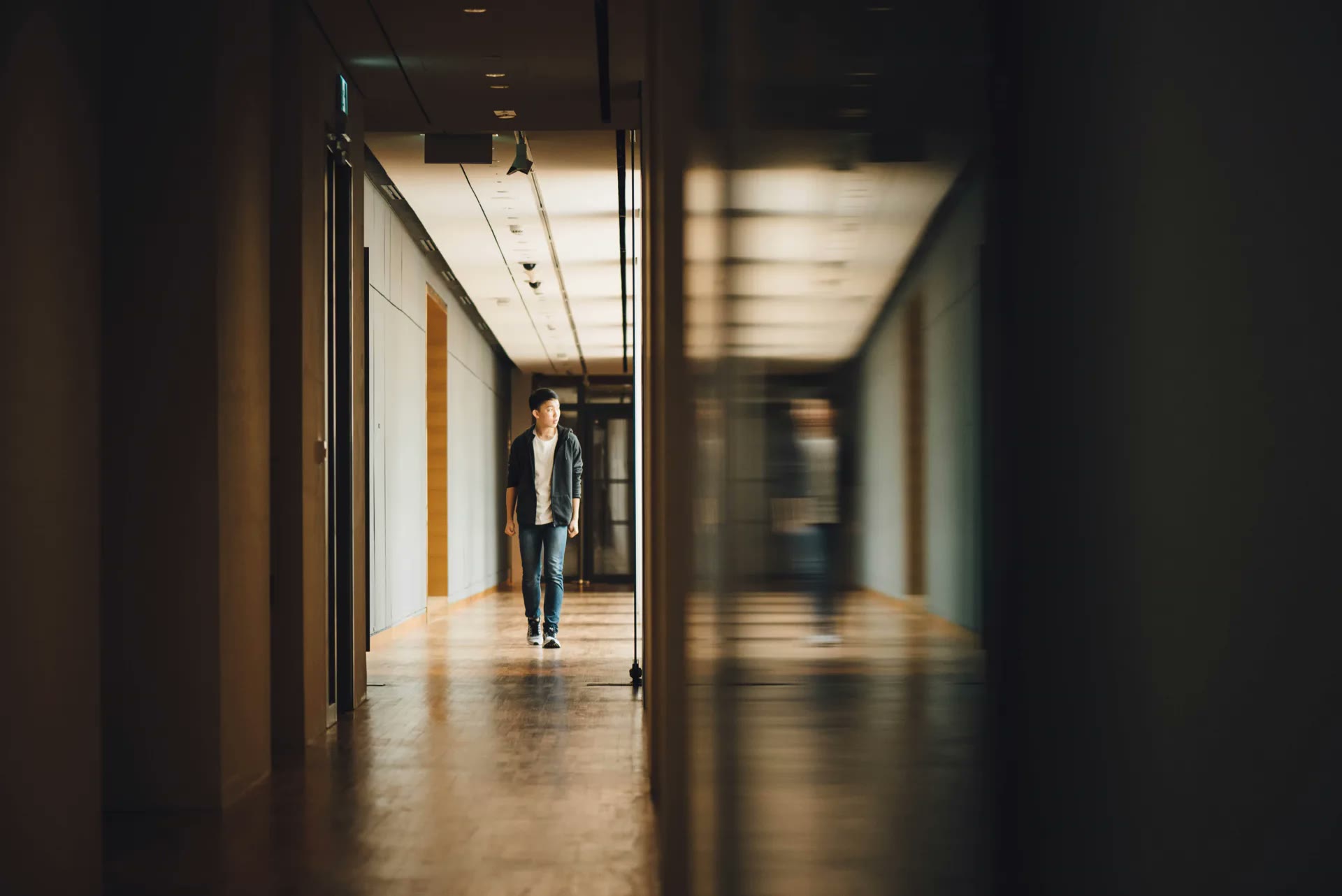
Photo: CHUTTERSNAP / Unsplash
How to Calm Down Before a Meeting (in the Time It Takes to Walk There)
The meeting starts in five minutes. Your chest is a little tight, your thoughts are rehearsing the same opening line for the fourth time, and some part of you is already replaying mistakes you haven't made yet. If that's you, you're in very normal company: the National Social Anxiety Center estimates as many as 75% of people feel some level of anxiety about speaking in front of others. The usual advice is to prepare more, which doesn't help when the meeting is in five minutes. This does. It's a three-minute reset built from breathing research, and you can do the whole thing in the time it takes to walk to the room.
- Up to 75% of people feel anxious about speaking in front of others, so pre-meeting nerves are the norm, not a flaw (National Social Anxiety Center).
- The fastest lever is your exhale: in a 2023 Stanford study, an exhale-heavy pattern called cyclic sighing improved mood more than mindfulness meditation.
- Renaming nerves as excitement measurably improves performance, because both feelings run on the same arousal (Harvard research, 2014).
- A full reset takes about three minutes: a few sighs, a slower walk, one small intention.
Why Do You Get So Nervous Before a Meeting?
Because your body thinks it's helping. When something matters and people will be watching, your nervous system releases adrenaline, speeds up your heart and breathing, and sharpens your attention. That response evolved for physical threats, so it arrives with more intensity than a status update needs. It isn't a character flaw. It's machinery.
Knowing that matters, because most people read the racing heart as evidence that something is wrong with them. It isn't. Surveys collected by the National Social Anxiety Center suggest as many as three in four people feel some fear of speaking in front of a group, which makes it one of the most widely shared anxieties there is. The confident-looking person across the table? Decent odds they're managing the same physiology, just with more practice.

What's the Fastest Way to Calm Your Body Down?
Change your breathing, and specifically, lengthen your exhale. In a 2023 Stanford Medicine trial published in Cell Reports Medicine, 111 volunteers practiced one of four techniques for five minutes a day over a month. The winner was cyclic sighing, an exhale-focused pattern: it improved daily mood roughly a third more than mindfulness meditation (a 1.91-point rise in positive affect versus 1.22) and produced the biggest drop in resting breathing rate (Balban et al., Cell Reports Medicine, 2023).
The single unit of that practice is often called the physiological sigh, and it's the part you can borrow five minutes before a meeting. Here's the whole technique:
- Inhale through your nose until your lungs feel comfortably full.
- Take one more short sip of air on top, a second, smaller inhale.
- Exhale slowly through your mouth until the air is completely gone. Make the exhale noticeably longer than the inhale.
That's one sigh. Two or three of them take under a minute, and nobody around you will notice you're doing anything at all. You already do this involuntarily: it's the double-intake breath your body produces after crying or right before deep sleep. You're just running it on purpose.
Your heart rate rises slightly on every inhale and falls slightly on every exhale. That's built-in. Spend more of each breath exhaling and you're leaning on the brake instead of the accelerator: the slow exhale activates the parasympathetic side of your nervous system, the one in charge of settling you down. You can't order your heart to slow down, but you can breathe in a way that asks it to.
The Walk-There Routine: Three Minutes, Three Steps
Here's how the pieces fit into the gap between your desk and the meeting room door. No app, no cushion, no closing your eyes at your desk while colleagues wonder if you're asleep.
- Before you stand up: two or three physiological sighs. Double inhale through the nose, one long exhale through the mouth. Under a minute, invisible, and it starts slowing your breathing rate immediately.
- On the walk: go slower than usual, and keep the exhale long. Walk at about 80% of your normal pace and let each breath out last longer than the breath in. Unclench your jaw. Drop your shoulders away from your ears. A slower body is a signal your brain reads as safety.
- At the door: rename the feeling and pick one intention. Quietly tell yourself "I'm ready" or even "I'm excited," then choose one small, concrete aim, like saying one thing in the first five minutes. One intention gives your attention a job, and nerves hate having a job.
Working from home? You lose the corridor but keep everything else. Do the sighs before you click join, roll your shoulders back, and set the same one-line intention. Even thirty seconds of this beats arriving at the call mid-adrenaline with your camera already on.

Does Saying "I'm Excited" Actually Work?
Surprisingly, yes, and it works better than telling yourself to calm down. In a series of Harvard experiments involving public speaking, karaoke, and timed math, people who said "I am excited" out loud before performing did measurably better than people who said "I am calm" (Brooks, Journal of Experimental Psychology: General, 2014).
The reason is that anxiety and excitement are nearly the same state in the body: elevated heart rate, heightened alertness, energy looking for somewhere to go. Trying to force that arousal down means fighting your own physiology, and it usually loses. Relabeling it costs nothing and points the same energy somewhere useful. It's a small example of how deliberate self-talk shapes what your mind does on autopilot: the words you choose become the interpretation your brain runs with.
Pick the next low-stakes meeting on your calendar, not the scary one, and run the full three-minute routine before it. Practicing on an easy meeting means the routine is familiar by the time a hard one comes around. You want the reset to be a habit, not a thing you're trying for the first time at your worst moment. The same is true of the dread that arrives before the week has even started, which is what beating the Sunday scaries is about.
Why a Daily Three Minutes Beats an Emergency Fix
The routine above works on the day. It works better on a calmer baseline. A 2023 meta-analysis of 12 randomized controlled trials, covering 785 adults, found that regular breathwork practice produced a significant reduction in self-reported stress compared with controls (Fincham et al., Scientific Reports, 2023). In other words, a few minutes of daily practice lowers the level your nerves start from.
And the dose is smaller than most people assume. In a 2025 randomized trial of 1,458 employees, just five minutes of meditation a day was enough to significantly cut perceived stress, with no statistically greater benefit beyond about ten minutes (JAMA Network Open, 2025). If you want the fuller picture of what a short daily practice does for stress, sleep, and focus, that research is covered in why meditation matters in a busy world. And if you're still deciding what kind of practice suits you, mindfulness vs. meditation breaks down the difference in plain terms.
The confidence practice in the free 3-Minute Meditation Pack was built for exactly the moment this article is about: right before something that matters. Three minutes, guided, done at your desk. If you have ten minutes instead of three, a short meditation can lower the anxiety itself, rather than just relabel it, and a 2026 study found it doesn't cost athletes their edge. And if the moment isn't a specific meeting at all, just a stretch of the day that's spiked, box breathing is the more evenly-paced cousin of the sigh above. If you would rather see all three options compared before picking one, the calming breath comparison lays them out together.
Frequently Asked Questions
How long does it take to calm down before a meeting?
Less time than you'd think. A slow, exhale-heavy breath called the physiological sigh starts lowering your heart rate within a few breaths, and a full reset takes about three minutes: a few sighs, a slower walk, and renaming the feeling as readiness.
What is the physiological sigh?
Two inhales through the nose, the second one a short top-up, followed by one long, slow exhale through the mouth. In a 2023 Stanford study, five minutes a day of this pattern improved mood more than mindfulness meditation and produced the biggest drop in resting breathing rate.
What if my heart is still racing when the meeting starts?
Let it race, and rename it. A racing heart before a meeting is arousal, and arousal also powers excitement. In Harvard research, people who said "I am excited" out loud performed better than people who tried to force themselves calm. You don't need a still heart to speak well.
Does this work for video calls too?
Yes. You lose the walk, but the other steps work at your desk. Do two or three physiological sighs before you click join, drop your shoulders, and set one small intention for the first five minutes. Joining thirty seconds early beats joining flustered and late.
The Bottom Line
Pre-meeting nerves aren't a verdict on your competence. They're arousal, arriving early and a little too loud. You now have a three-minute answer: two or three physiological sighs at your desk, a slower walk with longer exhales, and one renamed feeling with one small intention at the door. Use it on an easy meeting first, then keep it in your pocket for the hard ones. The meeting will still matter. You'll just walk in with your body on your side.
Start with the 3-Minute Meditation Pack
One short guided practice each for stress, sleep, and confidence, straight to your inbox.
Get the free pack- National Social Anxiety Center, Public Speaking Anxiety. Retrieved 2026-07-12. nationalsocialanxietycenter.com
- Balban, M. Y., Neri, E., Kogon, M. M., et al., Brief Structured Respiration Practices Enhance Mood and Reduce Physiological Arousal, Cell Reports Medicine, 2023. Retrieved 2026-07-12. cell.com
- Stanford Medicine, 'Cyclic Sighing' Can Help Breathe Away Anxiety, February 2023. Retrieved 2026-07-12. med.stanford.edu
- Brooks, A. W., Get Excited: Reappraising Pre-Performance Anxiety as Excitement, Journal of Experimental Psychology: General, 2014. Retrieved 2026-07-12. apa.org
- Fincham, G. W., Strauss, C., Montero-Marin, J., & Cavanagh, K., Effect of Breathwork on Stress and Mental Health: A Meta-Analysis of Randomised-Controlled Trials, Scientific Reports, 2023. Retrieved 2026-07-12. nature.com
- Effect of Meditation Dose on Perceived Stress: A Randomized Clinical Trial of 1,458 Employees, JAMA Network Open, 2025. Retrieved 2026-07-12. pmc.ncbi.nlm.nih.gov
This article is general educational content, not medical or psychological advice. If anxiety regularly interferes with your work or daily life, a qualified professional can help; see the disclaimer for detail.