
Photo: Olegs Jonins / Unsplash
Why Meditation Matters in a Busy World
Your phone buzzes before you've finished your coffee. By 9 a.m. you've answered a dozen messages, scrolled three feeds, and mentally rehearsed a meeting that hasn't happened yet. Sound familiar? In 2025, the American Psychological Association found that US adults rate their average stress level at 5 out of 10, and 77% say the future of the country itself feels like a source of strain (APA, Stress in America 2025). Meditation won't clear your inbox. But a growing stack of peer-reviewed research suggests it can change how your body and brain respond to everything else. Here's what the science actually shows, and how to start a practice that fits into a life that rarely slows down.
- US meditation use more than doubled in 20 years, from 7.5% of adults in 2002 to 18.3% in 2022 (Scientific Reports, 2024).
- An 8-week app-based program cut perceived stress nearly four times more than no treatment, in a 1,458-person randomized trial (JAMA Network Open, 2025).
- Just 5 minutes a day was enough to significantly cut stress, and meditating beyond about 10 minutes didn't add a statistically greater benefit.
- Meditation is linked to measurable brain changes, better sleep, and lower blood pressure (Harvard; Mayo Clinic).
How Busy Has Modern Life Actually Become?
In 2025, Pew Research Center found that 41% of US adults say they're online "almost constantly," a share that climbs to 63% among adults age 18 to 29 (Pew Research Center, Many Adults Worldwide Are Online Often or Constantly, September 2025). That's not a vague feeling of busyness. It's a measured, growing share of waking life spent tethered to a screen.
It isn't only screen time driving the strain. In its 2025 report, the APA found 69% of US adults feel stressed by misinformation, up from 62% just a year earlier, and stress tied to the country's future rose alongside it. Constant connectivity and constant uncertainty are compounding, not separate, problems.
The same 20-year stretch that turned constant connectivity into the norm also saw meditation adoption more than double. That's not proof one caused the other, but it lines up with what researchers keep finding: the more fragmented attention becomes, the more people reach for a practice built entirely around sustained, undivided attention, the same quality of attention covered in mindfulness vs. meditation.
Meditation Is Backed by Two Decades of Real Data, Not Just a Trend
In 2024, a peer-reviewed analysis of two decades of national health survey data found meditation use among US adults grew from 7.5% in 2002 to 18.3% in 2022, more than any other complementary health practice measured, ahead of yoga at 15.8% (Davies, Faschinger, Galante & Van Dam, Prevalence and 20-Year Trends in Meditation, Yoga, Guided Imagery and Progressive Relaxation Use, Scientific Reports, 2024). The National Institutes of Health's own tracking confirms the same trend line. That's a mainstream shift in how people manage stress, not a fringe habit.
What Happens to Your Brain and Body When You Meditate?
In 2011, Harvard-affiliated researchers at Massachusetts General Hospital found that participants who meditated about 27 minutes a day for 8 weeks showed measurable growth in the hippocampus, the brain region tied to memory and learning, along with reduced density in the amygdala, the region tied to stress and fear (Harvard Gazette, Eight Weeks to a Better Brain, 2011). The scans backed up what participants already felt: calmer.

More recent research put a number on the effect. In a 2025 randomized clinical trial of 1,458 employees published in JAMA Network Open, 8 weeks of daily app-based meditation cut perceived stress by 5.84 points on a standard scale, compared to just 1.45 points in a waitlist control group, a difference researchers rated as a large effect (Cohen's d = 0.85). Anxiety symptoms dropped by 3.13 points on the GAD-7 scale (d = 0.63), and depression symptoms dropped 2.55 points on the PHQ-8 (d = 0.58).
Here's the detail worth remembering: just 5 minutes a day was enough to significantly cut stress, and going beyond about 10 minutes a day didn't produce a statistically greater reduction. More isn't automatically better. Consistency is doing most of the work.
Can Meditation Help You Sleep Better?
In a 2015 randomized clinical trial published in JAMA Internal Medicine, older adults with sleep problems who practiced mindfulness meditation improved their Pittsburgh Sleep Quality Index score from 10.2 to 7.4, compared to a smaller improvement, from 10.2 to 9.1, in a sleep-education control group (Black et al., Mindfulness Meditation and Improvement in Sleep Quality, 2015). Researchers described the gap between groups as large and clinically relevant. Lower scores mean better sleep. This kind of measurable improvement is exactly what a good wind-down routine is designed to support.
Mayo Clinic's patient-education guidance rounds out the physical picture: regular meditation is associated with lower blood pressure, reduced cortisol, and a slower heart rate and breathing rate, alongside eased anxiety, chronic pain, and depression symptoms (Mayo Clinic, Meditation: A Simple, Fast Way to Reduce Stress). Mayo is clear that it works best as a complement to other care, not a replacement for it.
How Do You Fit Meditation Into a Day That's Already Full?
You don't need a retreat or an hour of silence. In the 2025 JAMA Network Open trial, just five minutes of meditation a day was enough to significantly cut stress, an amount that fits into a coffee break, a commute, or the five minutes before a laptop opens. What actually matters is showing up daily, not clearing your calendar. The easiest version of that for most people is a five-minute morning meditation, done before the day starts making demands.
When I first started meditating, I made excuses that I was too busy. Truth is, a few minutes is time anyone has, including me. What I did was take 2 minutes before I got into bed to start. Just 2 minutes. I wanted to do 10 minutes, but never did, so I gave myself permission to do 2 minutes instead. What I actually found was that even 2 minutes felt like a long time at first. But after a week or so, I noticed I was actually doing more than 2 minutes without realizing it.
So start with whatever you can. 1 minute, 2 minutes, don't stress about it. Just start. Over time you'll find, as I did, that it naturally gets longer. And just like any exercise, a little done regularly counts more than a mega session once in a blue moon. It does not have to be done sitting down either, which is the whole point of meditating without sitting still.
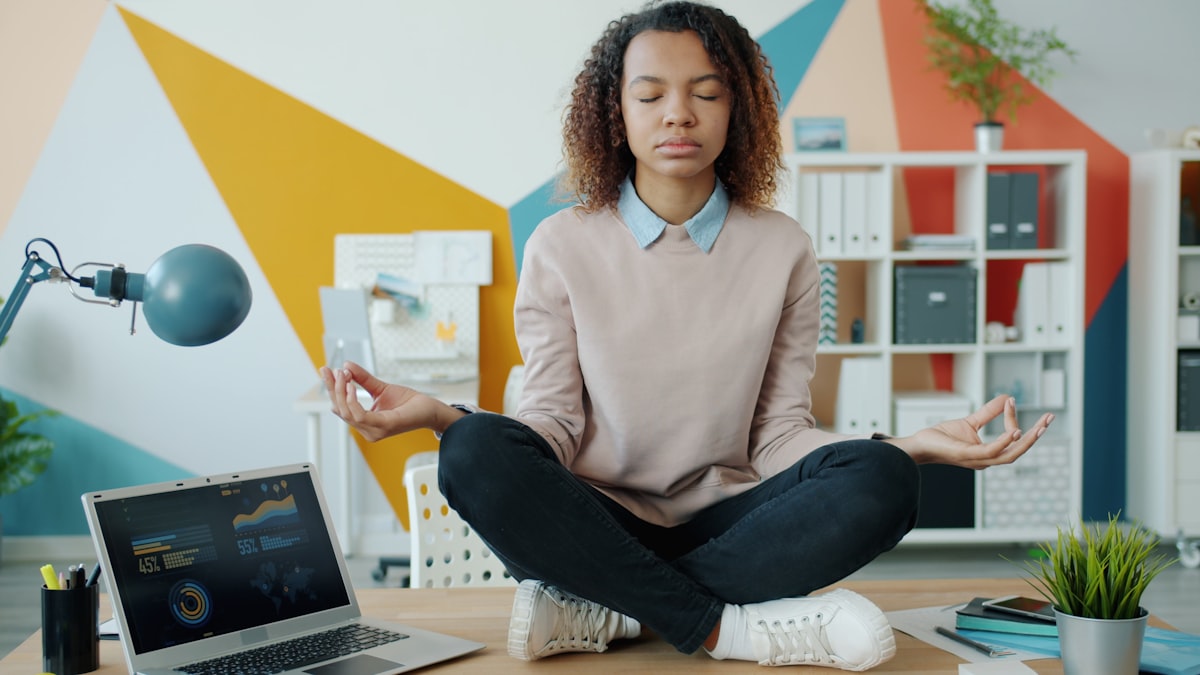
Before you open your laptop tomorrow, sit for 5 minutes and just follow your breath in and out. Not 20 minutes. Not a perfect posture. Five minutes, at the same point in your morning, every day this week. That small, repeatable dose is exactly what produced the biggest measured stress reduction in the research above.
Meditation Apps Are One On-Ramp, Not the Only One
In 2025, Calm was the highest-grossing meditation app worldwide, earning roughly $7.9 million in a single month, with Headspace close behind at $3.9 million, according to Statista's meditation and mental wellness app data. At the same time, downloads for both apps fell 60 to 70% between 2018 and 2024, while Insight Timer's free library grew past 220,000 guided meditations.
| App | Jan 2025 Revenue | 2018–2024 Trend |
|---|---|---|
| Calm | ~$7.9 million | Downloads down ~70% |
| Headspace | ~$3.9 million | Downloads down ~60% |
| Insight Timer | Free-tier led | Library grew past 220,000 meditations |
That split tells you something useful: paid apps still dominate revenue, but they're no longer the only entry point. If a subscription is a barrier, a free library or even a timer and a quiet room works for the practice described above.

How Do You Start a Meditation Practice as a Beginner?
Start smaller than feels productive. A 5-minute daily breath-focus session, done consistently, outperformed longer sessions in the stress-reduction data above. Here's a simple way to begin:
- Pick one fixed time. Right after waking up or right before opening your laptop both work well because they're already anchored to an existing habit.
- Sit somewhere ordinary. A chair, the edge of your bed, your desk. No cushion or app is required to start.
- Follow your breath for 5 minutes. When your mind wanders, and it will, just return attention to the next inhale.
- Use a guided track if silence feels hard. A free app or a single YouTube video is enough; the goal is repetition, not the tool.
- Track the streak, not the depth. Consistency over 8 weeks is what the research above actually measured, and it lines up with how your subconscious mind turns a repeated practice into an automatic one.

Frequently Asked Questions
How long does it take to see benefits from meditation?
Some benefits show up fast. In the 2025 JAMA Network Open trial of 1,458 employees, an 8-week program produced measurable stress reduction, with just 5 minutes a day already enough to make a significant difference. Brain-structure changes, like those in Harvard's 2011 MRI study, also appeared within 8 weeks of daily practice.
Is meditation backed by real scientific evidence, or is it just a wellness trend?
It's backed by peer-reviewed research, not just marketing. Harvard-affiliated researchers found measurable brain changes after 8 weeks of practice, and a 2025 JAMA Network Open randomized trial found meditation cut perceived stress nearly four times more than no treatment across 1,458 employees.
What's the easiest way to start meditating?
Start with 5 minutes of focused breathing at the same time each day, ideally right after waking up. Consistency matters more than duration. A 2025 clinical trial found just 5 minutes a day was enough to significantly cut stress, with no statistically greater benefit beyond about 10 minutes.
Do meditation apps work as well as in-person classes or therapy?
They can help, but they're a complement, not a replacement. Mayo Clinic classifies meditation as a complementary practice, not a standalone treatment. Calm and Headspace remain the top-grossing apps in 2025 per Statista, while Insight Timer's 220,000+ free meditations show paid subscriptions aren't required to start.
Can meditation help me sleep better?
Yes, according to a randomized clinical trial in JAMA Internal Medicine. Older adults with sleep problems who practiced mindfulness meditation improved their Pittsburgh Sleep Quality Index score from 10.2 to 7.4, a change researchers described as large and clinically relevant, compared to a smaller improvement in the control group.
The Bottom Line
Modern life isn't going to get quieter on its own. Notifications, news cycles, and always-on culture aren't a phase; Pew's 2025 data shows they're the new baseline, especially for adults under 30. Against that backdrop, meditation is one of the few interventions with two decades of adoption data and a growing pile of randomized trials behind it, not because it's trendy, but because 5 to 9.9 minutes a day is cheap, portable, and measurably effective. Start tomorrow morning, before the phone buzzes.
Start with the 3-Minute Meditation Pack
One short guided practice each for stress, sleep, and confidence, straight to your inbox.
Get the free pack- American Psychological Association, Stress in America 2025: A Crisis of Connection. Retrieved 2026-07-08. apa.org/pubs/reports/stress-in-america/2025
- Pew Research Center, Many Adults Worldwide Are Online Often or Constantly, September 2025. Retrieved 2026-07-08. pewresearch.org
- Davies, Faschinger, Galante & Van Dam, Prevalence and 20-Year Trends in Meditation, Yoga, Guided Imagery and Progressive Relaxation Use Among US Adults From 2002 to 2022, Scientific Reports, 2024. Retrieved 2026-07-08. nature.com
- NCCIH, Meditation Use: 20-Year Trends, citing Nahin, Rhee & Stussman, JAMA, 2024. Retrieved 2026-07-08. nccih.nih.gov
- Digital Meditation to Target Employee Stress: A Randomized Clinical Trial, JAMA Network Open, January 14, 2025. Retrieved 2026-07-08. pmc.ncbi.nlm.nih.gov/articles/PMC11733700
- Black, D.S., O'Reilly, G.A., Olmstead, R., Breen, E.C., & Irwin, M.R., Mindfulness Meditation and Improvement in Sleep Quality and Daytime Impairment Among Older Adults With Sleep Disturbances: A Randomized Clinical Trial, JAMA Internal Medicine, February 16, 2015. Retrieved 2026-07-08. jamanetwork.com
- Harvard Gazette, Eight Weeks to a Better Brain, reporting on Hölzel et al., 2011. Retrieved 2026-07-08. news.harvard.edu
- Mayo Clinic, Meditation: A Simple, Fast Way to Reduce Stress. Retrieved 2026-07-08. mayoclinic.org
- Statista, Meditation and Mental Wellness Apps – Statistics & Facts, 2025. Retrieved 2026-07-08. statista.com
Note: Gallup workplace-stress figures and a few "meditation statistics" claims found in secondary roundups (specific ROI/adoption percentages tied to executive behavior) could not be traced to a verifiable primary source and were intentionally left out of this article. Only claims confirmed against a named tier 1–2 source are included above.